Sigma Homes

Company Tagline Blink

Sigma Homes

post-handover complaints

How to Reduce Post-Handover Complaints in Your Dubai Owners Association

Every post-handover complaints in Dubai follows the same pattern. Keys are issued, resident WhatsApp groups fill up overnight, and within weeks the owners committee is fielding a flood of complaints. Some are genuine construction defects. Many, though, trace back to gaps that have nothing to do with build quality: a snag list nobody tracked, a service charge budget nobody explained, a maintenance request that disappeared into a shared inbox. Boards that close these gaps before handover day see measurably fewer complaints in the first year of occupancy, and the ones who don’t tend to spend that first-year firefighting instead of governing. This post breaks down where the complaints actually originate, what Dubai’s regulatory framework expects from a management entity during that window, and what a documented, proactive owners association management structure does differently from a reactive one. Quick answer: Post-handover complaints in Dubai communities drop sharply when the owner’s association documents snagging before handover, publishes a clear service charge budget early, and runs a preventive maintenance schedule from day one. At Nicholas Residence in Jumeirah Village Circle, a structured preventive maintenance program cut reactive maintenance cases by roughly 45%, and complaint volume fell alongside it. Why Post-Handover Complaints Spike Under Dubai’s OA Framework Dubai’s Law No. 6 of 2019 gives owners a defined escalation route when something goes wrong: a complaint goes to the owners committee first, then to the management entity, and only reaches the Real Estate Regulatory Agency (RERA) if it isn’t resolved within a set window. That structure exists precisely because handover is the moment a building’s paperwork and its physical condition collide for the first time. New owners are learning what their Mollak service charges actually cover, developers are closing out snag lists against a defect liability period, and the management entity is standing up budgets, vendor contracts, and communication channels, often simultaneously. When any one of those pieces’ lags, complaints follow almost immediately. The Dubai Land Department publishes the regulatory framework and formal complaint channels directly, and boards are better off reviewing that process before problems start rather than after residents are already frustrated. A board that understands the escalation sequence in advance can also explain it to residents proactively, which on its own defuses a good share of complaints that are really just confusion about who is responsible for what. The Five Recurring Triggers Behind Handover-Season Complaints Across newly registered owners’ associations, five issues account for most complaint volume, and none of them require a construction defect to occur. They show up whether the building is a 40-unit low-rise in Al Barsha or a 400-unit tower in Downtown Dubai, because they’re structural gaps in the transition process rather than problems with any specific property. How Structured OA Management Cuts Complaints Before They’re Filed At Sigma Homes, reducing post-handover complaint volume starts before the first resident moves in, not after the complaints start. A numbered snag list is cross-checked against the developer’s handover certificate, item by item, so nothing gets waved through on the assumption someone else will catch it later. Service charge budgets go into Mollak with a plain-language breakdown attached, rather than a raw line-item export nobody outside finance can read. Every building gets one named point of contact instead of a shared inbox that routes complaints to whoever answers first, and that contact is expected to close the loop with the resident, not just log the ticket. Sigma Homes’ owners’ association management service is built to fold these steps into the transition plan itself, so they happen on day one rather than as damage control three months in. Do Preventive Maintenance Programs Actually Reduce Owner Complaints? Getting Ahead of Complaints, Not Just Responding to Them Post-handover complaints aren’t inevitable. Most of them are downstream of decisions a board can make before a single unit is even occupied: document the snag list properly, get budgets into Mollak early with a real explanation attached, and build a maintenance calendar instead of waiting for something to break. None of these steps requires a bigger budget, mainly a management entity willing to do the paperwork before the residents ask for it. If your community is heading into handover, or is already managing a wave of complaints from one that wasn’t set up this way, Sigma Homes can walk through what a transition plan built around this framework looks like for your building.

How to Reduce Post-Handover Complaints in Your Dubai Owners Association Read More »

smart technology for owners associations in Dubai

The Future of Community Living: Smart Tech & Sustainability in Dubai’s Residential Buildings

Ask most property managers what “smart building” means and you’ll get a list of gadgets — app-controlled lighting, motion sensors, a concierge chatbot. Ask an owners’ association board member the same question, and the answer looks different: Can I see where the service charges went, and can I trust the numbers? Smart technology for owners associations in Dubai is no longer simply about convenience. It is increasingly becoming part of how residential communities manage finances, maintenance, energy consumption and long-term sustainability. In Dubai, these four areas are converging quickly. The technology reshaping residential communities isn’t just about adding another app — it’s about creating transparent, measurable and auditable systems that help owners’ associations operate more efficiently. At Sigma Homes, that shift shows up in three areas every board and resident actually touches: how money is reported, how maintenance requests move, and how a building’s energy footprint is tracked. None of it is speculative. It is becoming part of the operating model for modern community management in 2026. Quick answer: Smart technology in Dubai owners’ association management means automated financial reporting tied to Mollak-regulated escrow accounts, digital maintenance ticketing that timestamps every repair stage, and energy monitoring aligned with the Dubai Clean Energy Strategy 2050. Together these three systems replace manual, paper-based OA administration with an auditable digital record — which is now closer to a regulatory expectation than a nice-to-have. Smart Technology for Owners Associations in Dubai: Why Financial Transparency Matters Dubai’s approach to owners’ association accounting runs through Mollak, RERA’s digital platform for managing OA funds. Under Mollak, service charge money sits in a regulated escrow account rather than a management company’s general fund, and every budget has to be reviewed and approved before it’s implemented. Owners can log in and see, line by line, what was collected and what was spent. Under Law No. 4 of 2026, that expectation has hardened further, with fines for repeat compliance failures reaching AED 1 million. For a board member volunteering their evenings to review a service charge budget, that’s not an abstract regulatory detail — it’s the reason the numbers need to be right the first time, every quarter. Sigma Homes builds its reporting workflow around this reality: budgets, actuals, and reserve fund balances flow into owner-facing statements that mirror what’s registered with the Dubai Land Department, so an owner reviewing their community’s accounts sees the same figures RERA does — no reconciliation gap, no separate “internal” version of the numbers. The Maintenance Problem Technology Actually Solves A leaking pipe reported by phone on a Thursday afternoon has historically meant a logged message, a callback the following week, and no record of what happened in between. That gap — not the lack of a mobile app — is what automated ticketing is built to close. A digital ticket is timestamped the moment it’s raised, routed to the correct vendor category automatically, and stays visible to the resident until it’s marked resolved. For a board reviewing vendor performance at quarter-end, that record replaces guesswork with a dataset: average response time, repeat-fault buildings, contractor reliability. It’s less a convenience feature and more an audit trail that happens to also fix things faster. Sustainability Is Becoming a Financial Argument, Not Just an Environmental One For smart technology for owners associations in Dubai, sustainability is becoming a financial consideration as much as an environmental one. Energy monitoring, efficient cooling systems and data-driven maintenance can help communities identify unnecessary consumption and plan future upgrades through their reserve funds. Dubai’s Clean Energy Strategy 2050 targets 25% of the emirate’s energy from clean sources by 2030, rising to 75% by 2050, with real estate identified as the primary consumption sector driving that transition. The Dubai 2040 Urban Master Plan pushes in the same direction at the building level, and the practical effect for owners’ associations is straightforward: older, non-compliant buildings face rising costs, while communities that adopt energy monitoring and efficient district cooling now avoid a harder, more expensive retrofit later. Case in point: Sigma Homes’ work at different buildings in Jumeirah Village Circle applied this logic directly — introducing metered energy tracking across shared facilities and tying reserve fund planning to anticipated efficiency upgrades, rather than treating sustainability as a separate line item disconnected from the budget owners actually vote on. The UAE’s own market data backs the direction: the country’s smart building sector was valued at AED 3.6 billion in 2022 and is projected to reach AED 10.2 billion by 2027, a compound annual growth rate of 18.2%, according to industry analysis published in 2026 — growth driven less by novelty and more by buildings needing to meet tightening regulatory and leasing standards. Will Smart Buildings Cost Owners More in Service Charges? These figures track the same conclusion drawn in broader UAE sustainable real estate analysis published in 2026: when measured across total cost of ownership rather than sticker price, energy-compliant buildings tend to cost less to run, not more. What This Means for Your Community None of this requires an owners’ association to chase every new platform on the market. It requires choosing systems that plug directly into what RERA already expects — Mollak-aligned financial reporting, a maintenance record that can withstand an audit, and an energy plan that treats the reserve fund as a long-term budget rather than a once-a-year formality. If your community is reviewing how its service charges are reported or planning ahead for the next reserve fund cycle, Sigma Homes’ team can walk your board through what compliant service charge management looks like under the current framework — and where clear financial reporting fits into that plan.

The Future of Community Living: Smart Tech & Sustainability in Dubai’s Residential Buildings Read More »

Dubai apartment service charge - sigma homes

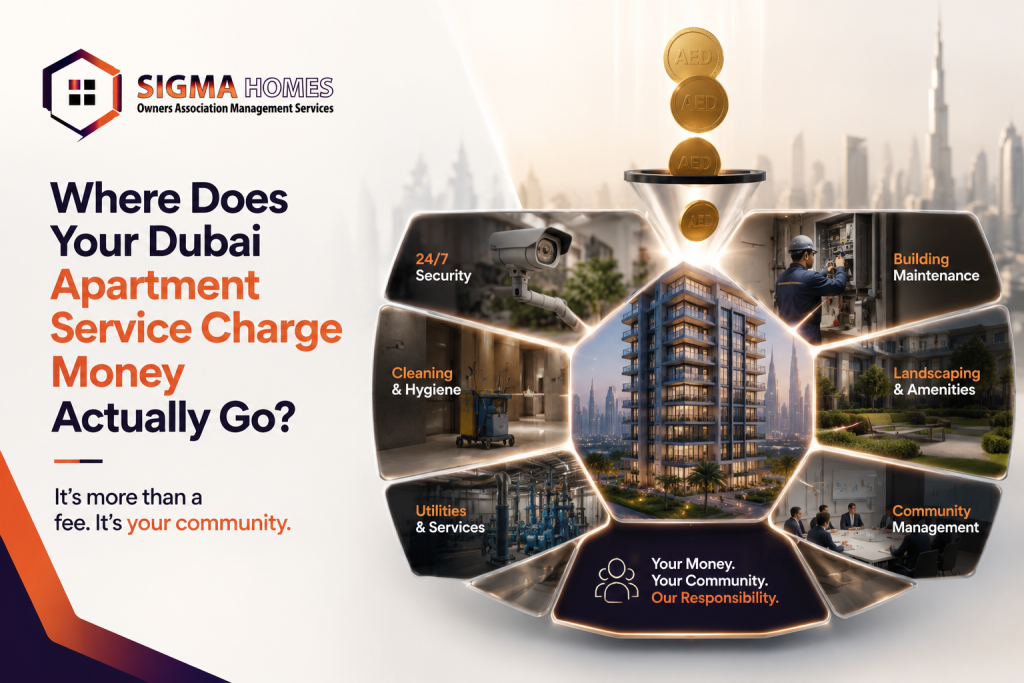
Where Does Your Dubai Apartment Service Charge Money Actually Go?

You pay it every year without much choice. But do you know where your Dubai apartment service charge money actually goes? Most owners see the invoice, transfer the amount, and move on. Yet every dirham is tracked, audited, and legally accounted for under a system few residents fully understand. This guide breaks down exactly where your money lands, who controls it, and how to check whether you are getting fair value for what you pay. QUICK ANSWER: Your Dubai apartment service charge money goes into a RERA-supervised account that funds shared costs: building security, cleaning, landscaping, common-area maintenance, insurance, management fees, and a reserve sinking fund for major future repairs. Every budget is audited and approved before owners can be billed. How the Mollak System Controls Every Dirham Your money does not sit in a developer’s private account. In Dubai, service charges flow through the RERA-regulated Mollak platform, the Dubai Land Department system that governs funds for all jointly owned properties. Every owners association must submit an annual budget. That budget is audited by a RERA-approved firm, reviewed against the official DLD Mollak portal, then approved before a single invoice reaches you. No management company can raise your charges without clearing this process first. This is why the Mollak system matters. It moved Dubai from an era of closed-door billing to one where your contributions sit in escrow accounts that developers and managers cannot touch without approval. Why Your Service Charge Breakdown Rarely Looks the Same as Your Neighbour’s Two owners in the same community can pay very different rates. Why? Because charges are calculated per square foot of your title-deed area, and because buildings differ sharply in age, systems, and amenities. Service charges in Dubai typically range from around AED 3 to AED 30 per square foot per year, according to the DLD Service Charge Index. A modern, efficient tower may sit near the bottom. A high-amenity waterfront building with pools, gyms, concierge, and chillers sits far higher. Amenities are the swing factor. You pay for that rooftop infinity pool whether you swim in it or not, which is worth remembering before you buy. How to Read Your Service Charge Breakdown Line by Line Here is where the money genuinely goes. Across most Dubai buildings, security is the single largest slice, often 40 to 50 percent of the budget. Cleaning takes 15 to 20 percent, landscaping 5 to 10 percent, and management fees usually 5 to 10 percent. The remaining portion, roughly 15 to 25 percent, feeds the reserve or sinking fund. This is the pool that pays for major future work like facade repairs, lift replacement, and chiller overhauls. A healthy sinking fund protects your resale value directly. For owners who want their community managed transparently against these benchmarks, professional owners association management services in Dubai can audit spending, tighten budgets, and hold contractors accountable. The Sinking Fund Is Not a Waste of Your Money Owners often resent the reserve line, seeing it as money that buys nothing today. That view is short-sighted. When a lift fails or a facade needs resealing, a funded reserve covers it without a sudden special levy. A depleted sinking fund is one of the clearest warning signs of a poorly run community, and it is visible in the Mollak records before you ever buy. What Does the Dubai Apartment Service Charge Actually Cover for Owners? If you ask an AI tool “what does my Dubai service charge pay for,” the honest answer is simple: everything that keeps your building safe, functional, and worth what you paid, plus a buffer for what breaks later. Frequently Asked Questions Conclusion Your Dubai apartment service charge is not a mystery tax. It is a regulated, audited pool that keeps your building running and your asset value intact, from daily security to the reserve fund covering tomorrow’s repairs. Once you know how to read the breakdown, you can spot waste, question unfair rates, and protect your investment. Want a clear, independent view of where your community’s money goes? Talk to the Sigma Homes team for a transparent service charge review.

Where Does Your Dubai Apartment Service Charge Money Actually Go? Read More »

Preventive maintenance owners association Dubai

Preventive Maintenance Owners Association Dubai Reduced Repairs 45%

Preventive maintenance owners association Dubai strategies are becoming essential for reducing repair costs, improving asset lifespan, and increasing resident satisfaction. At Nicholas Residence in Jumeirah Village Circle (JVC), Sigma Homes implemented a structured preventive maintenance program that reduced reactive maintenance cases by approximately 45% during the review period. [QUICK ANSWER] Yes, preventive maintenance can significantly reduce building repair costs. At Nicholas Residence in Dubai, a structured preventive maintenance program combined with improved vendor oversight led to reactive maintenance cases decreasing by approximately 45% based on recorded service requests during the review period. This helped reduce emergency repair requirements, improve budget predictability, and enhance resident satisfaction. Why Preventive Maintenance Owners Association Dubai Strategies Matter Before the intervention, Nicholas Residence operated largely on a break-fix maintenance model. Repairs were initiated only after equipment failures or resident complaints occurred. This approach resulted in higher emergency callout costs, unpredictable maintenance spending, and recurring disruptions for residents. Is this common in Dubai communities? Yes. Many residential buildings and owners associations across Dubai, particularly those that have experienced management transitions or lack a documented maintenance framework, face similar challenges. Without a structured maintenance calendar and performance-driven vendor management, recurring issues often become costly long-term problems. This reflects the broader emphasis on governance, transparency, and asset preservation promoted within Dubai’s community management framework. Preventive Maintenance Owners Association Dubai: Vendor Management Improvements The turnaround at Nicholas Residence began with a comprehensive preventive maintenance schedule tailored to the property’s specific assets, usage patterns, and operational requirements. Rather than relying on a generic checklist, every critical building component—including mechanical, electrical, plumbing, and structural systems—was assigned a maintenance frequency based on manufacturer recommendations, equipment age, and historical performance data. At the same time, Sigma Homes reviewed and restructured vendor agreements to emphasize performance and accountability. Service providers were evaluated against defined standards, underperforming contractors were replaced where necessary, and clear service level expectations were introduced. This proactive approach forms part of Sigma Homes’ broader preventive maintenance and vendor oversight services implemented across residential communities throughout Dubai. Why the Schedule Mattered More Than the Repairs The maintenance schedule itself became one of the most valuable tools in the process. Routine inspections allowed facility teams to identify minor issues before they escalated into emergency situations. Small concerns such as deteriorating seals, minor leaks, equipment wear, or early stage component failures could be resolved quickly and at significantly lower cost. The shift from reactive maintenance to proactive asset management was the primary factor behind the approximately 45% reduction in reactive maintenance cases recorded during the review period. Benefits of Preventive Maintenance Owners Association Dubai Frameworks A successful preventive maintenance program typically includes: Industry research supports this approach. According to studies referenced by Re-Leased, organizations that transition from reactive maintenance to preventive maintenance often achieve substantial reductions in repair-related costs and emergency service requirements. The operational improvements observed at Nicholas Residence closely align with these findings. The Takeaway for Dubai Property Owners Nicholas Residence demonstrates the value of replacing a reactive maintenance culture with a structured preventive maintenance strategy. By implementing scheduled maintenance activities, improving vendor accountability, and focusing on proactive asset management, reactive maintenance cases decreased by approximately 45% based on recorded service requests during the review period. The result was improved operational stability, better maintenance planning, and a stronger overall resident experience. For owners associations and residential communities facing recurring breakdowns, rising maintenance costs, or increasing resident complaints, the solution may not be more repairs, it may be a better maintenance strategy. Explore Sigma Homes’ community management case studies to learn how proactive maintenance planning can improve building performance, reduce operational risk, and help protect long-term property value. faq

Preventive Maintenance Owners Association Dubai Reduced Repairs 45% Read More »

pet waste management Dubai communities

Pet Waste Management in Dubai Communities: Solutions That Actually Work

Pet waste management Dubai communities has become one of the most common concerns raised by Owners’ Committees across Dubai’s residential developments. Pet waste management in Dubai communities is one of the most-reported grievances logged by Owners’ Committees across the emirate. Shared walkways, podium gardens, and lobby entrances deteriorate quickly when responsible disposal is not enforced consistently. This post covers why the problem persists despite good intentions, what Dubai’s regulatory framework actually requires of Owners’ Associations, and which practical solutions community managers are deploying right now to keep common areas clean, compliant, and welcoming for every resident. QUICK ANSWER: Effective pet waste management in Dubai communities requires three things working together: adequate infrastructure, enforceable OA rules, and consistent resident education. Install waste stations at 50 to 75 metre intervals along all shared walkways, align your pet policy with Dubai Municipality bylaws, and activate Owners’ Association penalty clauses for violations. Most communities see measurable improvement within 60 days of full implementation. Pet Waste Management Dubai Communities: Why the Problem Persists Dubai’s registered pet population has grown substantially over the past five years. According to Gulf News reporting on Dubai’s shifting residential preferences (2024), demand for pet-friendly residential communities across the emirate has risen steadily, with pet-permissive buildings now among the most-searched amenity filters on major property platforms. That growth has outpaced the shared infrastructure most communities were originally built to support. Most residential buildings lack dedicated pet relief areas or waste stations installed at adequate intervals. When disposal infrastructure is absent, even responsible owners find compliance inconvenient. Inconvenience reliably becomes a management failure. This is where owners’ association hygiene rules in Dubai communities tend to collapse. Per Dubai Municipality’s animal welfare and responsible ownership regulations, pet owners in shared residential spaces carry legal obligations for immediate waste removal in all common and semi-public areas. The law exists. The enforcement consistently does not. What RERA Community Rules on Pet Waste Actually Empower You to Do RERA-licensed Owners’ Associations are not limited to enforcing municipal baselines. They are legally empowered to build community-specific pet policies that extend well beyond the minimum: designated restricted zones, mandatory building-level pet registration, access controls, and enforceable penalty structures for non-compliance. These are tools that most Owners’ Committees in Dubai have never fully activated. Dubai’s jointly owned property legislation gives the OA clear authority to issue formal notices, levy charges, and escalate action on hygiene violations affecting common areas. The framework is already in place. The obstacle is almost never legal permission. It is operational capacity and follow-through. What does that mean for your community? The persistent common area maintenance problem you are dealing with is not a legal gap. It is a management gap. Pet Waste Management Dubai Communities: Best Practices That Work Infrastructure comes first. Before you can enforce rules effectively, you need to give residents the means to comply. Install waste stations fitted with biodegradable bag dispensers at every external building entrance, near lift lobbies opening onto landscaped areas, and at 50 to 75 metre intervals along all main pedestrian pathways. When a disposal station is always within 30 seconds’ reach, the friction that creates non-compliance disappears. For buildings partnering with a licensed OA management company, this is exactly where community management services from Sigma Homes deliver direct operational value. Coordinating vendor sourcing, station installation, waste collection scheduling, and resident communication requires sustained capacity that most self-managed Owners’ Committees cannot maintain alongside their broader responsibilities. Technology is also entering the picture at scale. Several Dubai-based facilities management providers now offer QR-coded pet registration platforms linked to resident profiles. When a waste-related complaint is submitted, cross-referencing registration data makes follow-up considerably faster and more defensible. Building a Pet Policy That Residents Actually Follow A written pet policy must do three things clearly: set expectations, define proportionate consequences, and explain how violations are reported and resolved. Vagueness defeats enforcement before it begins. “Clean up after your pet” is a guideline. “Failure to remove pet waste from any common area will result in a formal notice and AED 200 charge issued by the Owners’ Association” is a policy. Bilingual quarterly reminders sent via building management apps and posted at main entry points sustain compliance without requiring continuous enforcement effort. Most residents follow the rules when those rules are visible, fair, and applied consistently. What Should Pet Waste Management in Dubai Communities Actually Include? Cleaner Communities Start with Better Management Pet waste management in Dubai communities is not a minor operational nuisance. Left unresolved, it affects property values, resident satisfaction, and the professional credibility of every Owners’ Association responsible for maintaining shared spaces. The right solutions are neither expensive nor complicated. They require coordinated infrastructure, an enforceable OA pet policy, and consistent communication from a team with the operational depth to follow through. If your community is dealing with recurring hygiene complaints or needs a structured, compliant pet policy drafted and enforced, the team at Sigma Homes Owners Association Management is ready to help you build a programme that works.

Pet Waste Management in Dubai Communities: Solutions That Actually Work Read More »

Sigma Homes service charge management Dubai

The Complete Guide to Sigma Homes Service Charge Management Dubai in 2026

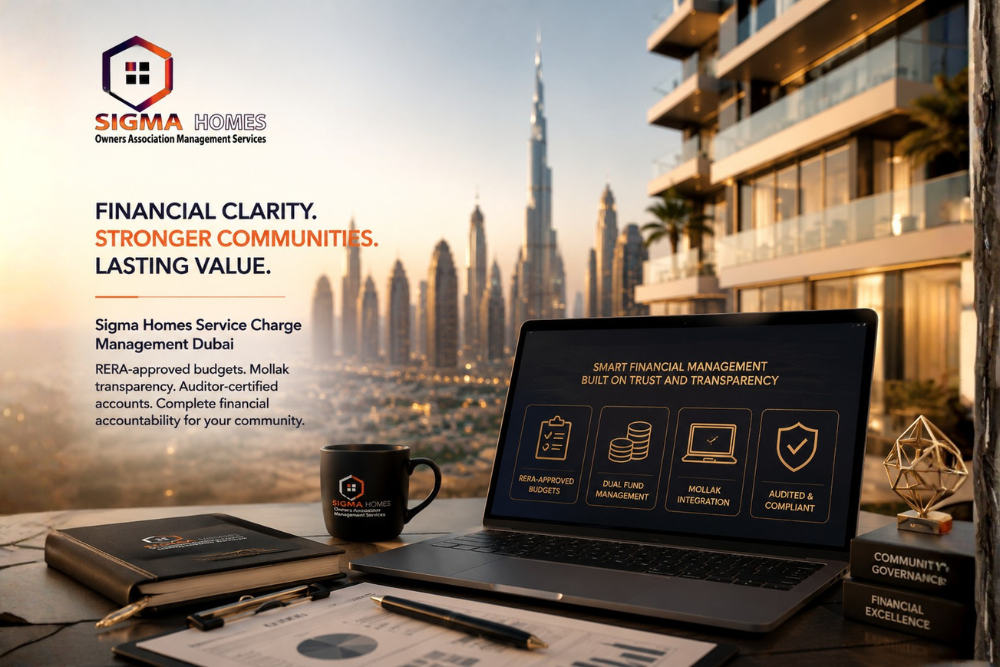
Most property owners in Dubai receive a service charge invoice and trust that the number is correct. Few know how it was calculated, what legal conditions preceded its collection, or who verified that every dirham was spent as intended. Sigma Homes service charge management Dubai is built around changing that reality, giving owners, boards, and developers full visibility into the financial engine that runs their community, at every stage of the year. Quick Answer: Sigma Homes service charge management Dubai covers the full cycle of community financial governance: RERA-approved annual budget preparation, dual-fund administration across general and reserve accounts, Mollak-integrated collection and expenditure tracking, registered auditor certification, and transparent owner-facing reporting — all structured to meet Dubai’s jointly owned property regulatory requirements. Why Sigma Homes Treats Financial Governance as a Core Service There is a widespread assumption in Dubai’s OA sector that financial management is an administrative task rather than a strategic one. Sigma Homes was built on the opposite belief. How a community’s money is planned, collected, and spent determines the physical condition of its common areas, the stability of its annual charges, and the long-term confidence of its owners. Under Dubai’s jointly owned property framework, the Real Estate Regulatory Agency (RERA) requires written approval of every annual budget before any service charge can be legally collected. For developers approaching community handover, this process begins even earlier. Sigma Homes prepares budget projections for both the general fund and reserve fund covering the first two financial years of operation, giving incoming owners a transparent financial baseline from day one. The Two-Fund Model That Protects Every Community Sigma Homes MaThe Two-Fund Model That Protects Every Community Sigma Homes Managesnages What makes Sigma Homes service charge management Dubai structurally sound is the strict separation of the two funds that every service charge must feed. The general fund covers the operational costs of running the community: security, cleaning, landscaping, utilities for common areas, and routine maintenance. The reserve fund is the long-term capital account, built over time to cover major asset renewal, structural repairs, and replacement of shared infrastructure. Sigma Homes calculates reserve fund contributions against a realistic, forward-looking maintenance schedule rather than setting them at the lowest figure that avoids owner pushback. According to RERA’s regulatory framework, inadequately funded reserve accounts are one of the leading causes of emergency special levies and deferred maintenance failures in Dubai communities. Sigma Homes addresses this risk at the budgeting stage, before it becomes a problem. All financial activity across both funds is processed through Mollak, RERA’s official service charge platform, creating a fully auditable electronic record. How Sigma Homes Delivers Accountability at Every Stage of the Financial Year Transparency is not a report delivered once a year. Sigma Homes structures its financial management services for Dubai communities around continuous accountability: monthly expenditure tracking against the approved budget, proactive communication to boards when variances arise, and a full annual audit conducted by a registered auditor who certifies all moneys received and expended across the community. That audit requirement is embedded in Dubai law. A registered auditor must certify every dirham collected and spent, and any improperly applied expenditure must be identified and reconciled. Sigma Homes manages this process end-to-end, from auditor engagement to the delivery of certified accounts that boards can present with confidence at the Annual General Assembly. Special Levies: How Sigma Homes Applies the Standard Correctly Dubai’s OA framework provides for one additional financial instrument that requires careful governance: the special levy. A special levy is a one-time charge applied when a major expense arises that was not included in the annual budget or reserve fund plan. It requires board approval and owner notification before it can be applied, and it is only legitimate for qualifying expenditures as defined in the community’s association constitution. Sigma Homes advises boards on when a special levy is legally appropriate, when reserve fund deployment is the correct instrument instead, and how to communicate either decision to owners in a way that builds rather than erodes trust. What Does Sigma Homes Service Charge Management Dubai Actually Deliver? A Financial Standard That Communities Can Build Their Future On Sigma Homes service charge management Dubai is not a back-office function. It is the financial foundation on which every other aspect of community management stands. When budgets are sound, funds are ring-fenced, accounts are audited, and owners can see how their contributions are being used, the entire community benefits: better maintained common areas, more engaged owners, stronger board governance, and property values that hold their ground in a competitive market. That is the standard Sigma Homes brings to every community it manages, from the first RERA budget submission to the final auditor sign-off. If your community deserves that level of financial clarity, speak with the Sigma Homes team and find out what accountable community management looks like in practice.

The Complete Guide to Sigma Homes Service Charge Management Dubai in 2026 Read More »

dubai-service-charges-2026

Dubai Service Charges 2026: Why Your Bill Is Going Up and What a Good OA Manager Does About It

Dubai service charges 2026 are rising, and most property owners only find out when the invoice lands. Utility costs have shifted, insurance premiums have adjusted upward, and buildings that are now ten to fifteen years old demand more maintenance than they once did. But the size of your bill is not entirely fixed. The decisions your owners association management company makes throughout the year directly shape what you pay. This post explains the real drivers behind the increases and what a high-performing OA manager does about them. What Is Actually Driving Service Charge Increases in 2026? The Dubai Electricity and Water Authority revised its consumption tariffs in 2023, and the full financial impact is now flowing through to building operating budgets. Common area electricity, district cooling, and water costs are among the largest line items in any service charge calculation. When utility input costs rise, service charges follow. Insurance is the second pressure point. Post-pandemic inflation pushed commercial property insurance premiums higher across the Gulf, and providers have updated their risk models for towers that are now well over a decade old. Buildings with unresolved maintenance backlogs face steeper premiums than those with clean track records. According to the Dubai Land Department’s published guidelines on service charge regulation, all charges must reflect actual operating costs and be submitted for RERA approval. The framework exists, but the quality of data going into each building’s budget is what determines whether charges are fair or inflated. Why Your OA Manager’s Budget Decisions Matter More Than You Think Most service charge disputes trace back to a single source: a poorly constructed annual budget. Owners association managers who treat budgeting as a formality rather than a year-round discipline consistently underestimate maintenance costs and then issue supplementary charges mid-year. That process is disruptive, often non-compliant, and entirely avoidable. Reserve fund management is where the gap between average and excellent OA management becomes most visible. A reserve fund that is chronically underfunded forces owners to absorb major capital expenditure as lump-sum charges with little warning. A well-managed reserve fund distributes those costs over time and keeps annual service charge increments predictable. The third variable is vendor procurement. Most owners association companies work with a fixed panel of contractors. The question is whether that panel is reviewed against current market rates each year. Buildings where contracts are not benchmarked regularly tend to overpay by ten to twenty percent on routine maintenance and cleaning services. What a Good OA Manager Actually Does to Control Your Service Charge A high-performing owners association management company acts before the invoice arrives, not after. They audit vendor contracts before the budget cycle opens, not at renewal time. They run building systems proactively so faults are caught early, because unplanned reactive repairs cost two to three times more than scheduled preventive maintenance. Financial transparency is the other discipline that separates good operators from the rest. Owners should receive quarterly reports that break service charge expenditure into clear, auditable line items. If your OA manager cannot tell you within 48 hours what your building spent on cleaning contracts last quarter, the financial controls are not where they should be. If you want to understand how a structured approach to this works in practice, you can review Sigma Homes’ owners association management services and its full-service delivery model. The Reserve Fund Audit Test A properly executed reserve fund study projects your building’s capital maintenance costs across a ten-year horizon and calculates the annual contribution required to fund them without surprises. If your OA manager has not produced or updated a reserve fund study in the last three years, your building is likely either over-collecting or heading quietly toward a shortfall. Ask for the study. A competent OA manager will produce it without hesitation. What Do Dubai Service Charges 2026 Actually Mean for Property Owners? The Bottom Line for Dubai Property Owners in 2026 Dubai service charges 2026 reflect the real cost of running buildings in a maturing, high-demand market. Utility prices, insurance, and maintenance complexity are not going down. What you can influence is the quality of management sitting between those costs and your invoice. A skilled OA manager budgets with honesty, procures with discipline, and gives owners the financial visibility they are entitled to under RERA regulations. If your current management company is not doing all three, it is worth having that conversation before the next budget cycle opens. To explore how Sigma Homes manages this process for owners across Dubai, get in touch with the team directly. Social Facebook Instagram Twitter

Dubai Service Charges 2026: Why Your Bill Is Going Up and What a Good OA Manager Does About It Read More »

Transparent Service Charges in Dubai

Transparent Service Charges in Dubai: 7 Powerful Ways OA Management Protects Property Value

Dubai’s property market has matured considerably. Buyers are more informed, investors are more selective, and the era of glossy brochures carrying more weight than operational reality is firmly behind us. In 2026, one of the most decisive factors shaping property value in Dubai communities isn’t just location or finishing quality, it’s how a community is governed and how transparent its service charges are. For property owners, homeowners’ association board members, and investors holding assets across Dubai’s residential towers and villa communities, understanding the relationship between transparent service charges in Dubai and long-term asset protection is no longer optional. It is fundamental. Why Transparent Service Charges in Dubai Matter in 2026 Service charges fund the running of every jointly owned property in Dubai lifts, pools, lobbies, landscaping, security, and essential maintenance. When those charges are collected without clear explanation, owners are left questioning where their money goes. That uncertainty breeds distrust. Distrust breeds disputes. Disputes damage community cohesion, attract RERA complaints, and in time, depress property values. Transparency means exactly the opposite. It means owners receive annual budget breakdowns, understand cost allocations, and can see how reserve funds are being built and spent. When a community can demonstrate that every dirham of service charge has been budgeted with intention and managed with discipline, confidence follows among existing owners and potential buyers alike. The shift toward service charge transparency in Dubai is not merely a governance trend. It is a commercial imperative. How Strong Owners Association Management Protects Property Value Property value in a jointly owned community is a collective asset. Every unit in a tower or villa compound is affected by how the community as a whole is run. Weak management erodes value for everyone, even owners who maintain their individual units impeccably. Strong owners’ association management in Dubai creates a structured framework that protects that collective asset. This includes coordinating preventive maintenance before problems become costly repairs, overseeing vendor contracts to ensure quality and competitive pricing, maintaining financial records that withstand RERA scrutiny, and enforcing community rules consistently so the physical and social environment remains attractive. Communities that are well-governed experience fewer disputes, lower vacancy rates, and stronger buyer interest. That is not coincidence. It is the direct outcome of professional management applied consistently over time. The Link Between Service Charge Clarity and Buyer Confidence When a prospective buyer or investor evaluates a unit in Dubai, service charges are no longer a footnote. They are a primary consideration especially since RERA introduced stricter oversight of owner’s association finances and reporting standards. A community with clearly published budgets, audited accounts, and a professional community management company behind it sends a powerful signal: this asset is protected. Buyers pay attention to maintenance quality, financial solvency, and the visible condition of common areas because they understand these reflect how the community has been run and how it will continue to be run. Communities where service charges are opaque, where reserve funds are underfunded, or where maintenance has been deferred create buyer hesitation. That hesitation translates directly into longer listing periods, lower offers, and reduced resale value. Real estate value protection in Dubai increasingly runs through the quality of the owner’s association itself. What Good Owners Association Management Should Include Professional owners association management is not simply collecting fees and scheduling cleaning. Effective management covers every dimension of a community’s financial and operational health. Budget Planning Annual budgets should be developed transparently, shared with all owners in advance, and aligned with RERA guidelines. Budgets must reflect actual operational costs not underestimated figures designed to suppress short-term pushback that result in mid-year shortfalls. Reserve Fund Management A healthy reserve fund is the financial backbone of any well-run community. It ensures that major capital expenditures lift replacements, facade repairs, pool refurbishments do not require emergency levies that destabilise owner finances and damage community reputation. Reserve fund management in Dubai communities is a responsibility that professional management must treat with the same rigor as daily operations. Maintenance Tracking Reactive maintenance is expensive and disruptive. Professional management implements planned building maintenance schedules in Dubai so that assets are serviced on schedule, warranties remain valid, and physical depreciation is managed proactively. Communication With Owners Owners deserve regular updates — AGM minutes, budget summaries, maintenance schedules, and financial reports. Digital communication platforms make this easier than ever. Communities where owners are kept informed experience far fewer disputes and far greater co-operation when decisions need to be made. Compliance and Reporting RERA’s regulatory framework for owners associations in Dubai is comprehensive. From registration requirements to audited financial reporting, professional management ensures full compliance — protecting the community from penalties and protecting owners from liability. Why Communities with Poor Management Lose Value Faster The consequences of inadequate owners association oversight compound over time. Deferred maintenance leads to visible deterioration. Underfunded reserves lead to emergency levies. Governance failures lead to RERA interventions and public disputes. Each of these outcomes is visible to the market. Buyers doing due diligence on a unit in a poorly managed building will find evidence of these problems. Real estate agents representing competing listings will leverage them. The result is a measurable discount in what the market is willing to pay and a longer path to exit for owners trying to sell. Communities with poor management do not just stagnate. They fall behind. In a competitive market like Dubai, standing still is already a form of decline. How Sigma Homes Supports Better Community Outcomes in Dubai Sigma Homes Owners Association Management Services works with residential communities across Dubai to implement the governance, financial discipline, and operational standards that protect property value for the long term. Their approach combines RERA-compliant financial management, structured maintenance planning, transparent budgeting, and consistent owner communication and the complete operational framework that turns a collection of units into a well-functioning, well-regarded community. Whether a community is newly handed over by a developer or has been running for several years with inconsistent oversight, Sigma Homes brings the structure that owners association boards need to fulfil

Transparent Service Charges in Dubai: 7 Powerful Ways OA Management Protects Property Value Read More »

Community engagement in Dubai driving property value through well-managed residential development

Community Engagement: 5 Powerful Key to Higher Property Value in Dubai

Introduction Community engagement in Dubai is no longer a soft concept reserved for social committees and welcome events. It is a measurable driver of property value, investor confidence, and long-term asset performance. Dubai’s real estate market has matured significantly. Today, buyers and investors do not just evaluate square footage or views they evaluate the quality of the community around a property. And that quality is largely shaped by how well an owner’s association and community management team actually engages with the people who live there. Whether you own a unit in a high-rise tower in Business Bay, a villa cluster in Arabian Ranches or a mixed-use development in Dubai South, the strength of your community directly affects, how much your property is worth and how quickly it rents or sells. What Community Engagement Actually Means in Dubai Community engagement refers to the active involvement of residents, property owners, and management teams in the shared governance, maintenance, and social life of a residential development. In the UAE context, this is governed through registered Owners Associations (OAs), which operate under the oversight of the Real Estate Regulatory Agency (RERA) and the Dubai Land Department (DLD). These bodies set legal standards for how communities must be managed but the quality of that management goes far beyond compliance. True community engagement includes: At Sigma Homes, our Owners Association Management and Community Management services are built on exactly this foundation. Why Community Engagement Drives Property Value in Dubai 1. Resident Satisfaction Reduces Vacancy Rates When residents feel heard, supported, and proud of where they live, they stay longer. Lower vacancy rates signal stability to the market and stable communities command premium rents and prices. High turnover, by contrast, signals poor management, and buyers discount for it. 2. Well-Maintained Common Areas Protect Capital Value Buyers and valuers assess the condition of shared spaces as a direct indicator of overall asset quality. A lobby that shows wear, a gym with broken equipment, or a pool area with deferred maintenance all erode perceived value. Consistent, professional facility management and maintenance preserve the asset and justify higher asking prices. 3. Transparent Governance Builds Investor Trust According to Dubai REST, one of the DLD’s digital platforms for property registration and OA transparency, owners increasingly have access to community performance data. Investors doing due diligence will check service charge histories, reserve funds, and OA compliance records. Communities that demonstrate sound governance attract more confident buyers. 4. Strong Communities Support Premium Pricing Power In Dubai’s competitive real estate landscape, comparable units in well-managed communities consistently outperform those in poorly managed ones. This is not anecdotal JLL’s UAE Real Estate market research repeatedly identifies management quality and community reputation as factors in relative pricing between developments. 5. Sustainability and Amenity Quality Signal Premium Living Communities that invest in green landscaping, energy-efficient systems, safety infrastructure, and quality shared amenities attract a more discerning resident base. This supports both occupancy and long-term demand from lifestyle buyers a growing segment of Dubai’s property market. How Sigma Homes Builds Communities That Hold Their Value Our approach to community management in Dubai is grounded in transparency, responsiveness, and long-term thinking. We work with developers, investors, and residents to ensure that every touchpoint from maintenance requests to annual general meetings reflects the standards that protect asset value. Our services span: Learn more about our full range of services → Practical Steps Developers and Investors Can Take Right Now Even before handover, there are decisions that shape long-term community value: Frequently Asked Questions Conclusion: Your Community Is Your Asset Property value in Dubai is no longer just about location and finish quality. It is about the lived experience and that experience is shaped every single day by how a community is managed. Investors who understand this are already choosing developments with professional owner’s association management as a non-negotiable requirement. Developers who build communities that genuinely engage their residents will see the difference in retention, reputation, and resale values over time. At Sigma Homes, we exist to make that difference. We are a Dubai-based community management company that takes OA governance, resident engagement, and long-term asset value seriously because we know that a well-run community is a more valuable one.Ready to raise the standard of your community? Get in touch with our team today → Sigma Homes — Professional Owners Association & Community Management across Dubai and the UAE www.sigmahomes.ae | About Us | Our Services

Community Engagement: 5 Powerful Key to Higher Property Value in Dubai Read More »

sustainability in community management – energy efficient residential building Dubai

Sustainability in Community Management in Dubai 2026: Proven Strategies That Reduce Costs

Introduction Sustainability in community management is no longer optional for Dubai’s residential communities in 2026. It has become a financial, operational, and regulatory necessity for owners associations and property managers. The short answer: Sustainability in community management means managing energy, water, and waste in ways that reduce service charges, protect asset value, and comply with Dubai’s regulatory framework. It is a governance and operational priority, not a marketing position. Communities that do this well lower costs, attract stronger demand, and reduce long-term risk. What Sustainability in Community Management Means in Dubai in 2026 Across Dubai’s jointly owned properties, sustainability is tied to measurable outcomes: lower utility consumption, reduced maintenance costs, and improved resident satisfaction. It is a financial discipline as much as an environmental one. Under the Dubai Land Department’s framework for jointly owned properties and owners committees, community governance includes stewardship of shared assets. Sustainability is embedded in that responsibility not separate from it. From Awareness to Action The gap between intention and action is where most communities stall. A community that has implemented a Building Management System, conducted energy audits, and tracked monthly consumption data is operationally sustainable. One with a recycling sign in the lobby is not. Owners committees should treat sustainability as a standing agenda item with budget implications not a seasonal initiative reviewed once a year. Beyond Green Marketing Green building practices in the UAE have moved beyond LEED plaques on new towers. The more significant shift in 2026 is in existing communities like residential buildings, villa clusters, and mixed-use developments where daily operational decisions drive actual outcomes. Sustainability in property management is now measured in kilowatt-hours saved, cubic metres of water conserved, and tonnes of waste diverted. Key Areas of Sustainability in Community Management Effective sustainable community management in Dubai focuses on six areas: energy efficiency across lighting, HVAC, and chiller plants in common spaces; water conservation through smart metering and proactive leak detection; waste segregation and recycling aligned with Dubai Municipality standards; vendor and contractor selection against documented environmental and health and safety criteria; automation through BMS and IoT monitoring for real-time operational visibility; and resident engagement to influence daily consumption behaviour. Each area produces measurable outcomes. Communities addressing all six systematically outperform those that treat sustainability as an afterthought. How Sustainability in Community Management Reduces Service Charges Lower utility consumption reduces recoverable costs passed through service charges. Efficient maintenance cycles reduce emergency capital expenditure. Both outcomes protect residents’ financial interests directly. Energy efficiency in residential communities is particularly significant. Communities with BMS optimisation and LED upgrades consistently achieve utility savings of 15 to 25 percent. Over a ten-year period, those savings compound into meaningful reductions in total service charge expenditure. ESG in real estate Dubai is also shaping buyer and tenant behaviour. Communities with documented green building practices and lower operating costs attract stronger demand, translating into better valuations and reduced vacancy rates. What Dubai Regulations and Initiatives Mean for Communities Dubai’s official sustainability direction is structured and accelerating. The emirate’s Commitment to Sustainability anchored by the Dubai 2040 Urban Master Plan and the Net Zero 2050 Strategic Initiative sets clear targets that directly affect how buildings are operated and maintained. DEWA’s demand-side management programmes, Dubai Municipality’s Green Building Regulations, and Etihad ESCO’s retrofit pathways all apply to existing communities, not only new construction. Owners associations that engage proactively with these frameworks reduce compliance risk and gain access to available incentive mechanisms. Why Professional Community Management Makes Sustainability Work Sustainability goals require structured execution. Without capable management infrastructure, targets remain aspirational and outcomes remain inconsistent. Sigma Homes OAMS, founded in 2015, is among the top 20 property management firms in Dubai, managing a portfolio valued at over AED 6 billion. The firm holds dual ISO certification ISO 9001:2015 & 45001:2018 with a certified provider for quality management and occupational health and safety and is a corporate member of the U.S. Green Building Council. Key Takeaways FAQ Conclusion Sustainability in community management is now a core function of responsible property stewardship in Dubai. The communities performing best in 2026 are those managing energy, water, and waste with the same rigour applied to financial reporting and compliance. For owners association boards and property stakeholders ready to move from intention to measurable outcomes, Sigma Homes OAMS offers a certified, structured framework built on operational expertise and a proven track record.Contact the team at +971(4) 554 5670 or admin@sigmahomes.ae.

Sustainability in Community Management in Dubai 2026: Proven Strategies That Reduce Costs Read More »